
When it comes to keeping your car road-legal and safe, the MOT test is a non-negotiable requirement. Every vehicle over three years old in the UK is required to pass an annual MOT (Ministry of Transport) test, which ensures that your car meets strict safety and environmental standards. Yet, every year, thousands of motorists fail their MOTs on simple, avoidable issues, such as worn wiper blades, bald tyres, or faulty bulbs.
In fact, DVSA statistics show that nearly 30% of cars fail their MOT on the first attempt, often due to minor issues that could have been easily fixed at home in minutes. That’s why preparing ahead with a complete MOT checklist can save you time, money, and the stress of a retest.
At Autoveto Garage, we’ve compiled the ultimate MOT test checklist for 2025, ensuring you know exactly what’s covered, what to check before your appointment, and how to avoid the most common pitfalls.
Pre-MOT Checks You Can Do in 10 Minutes
You don’t need to be a mechanic to give your car a quick once-over before heading to the garage. These small steps can make the difference between passing and failing.
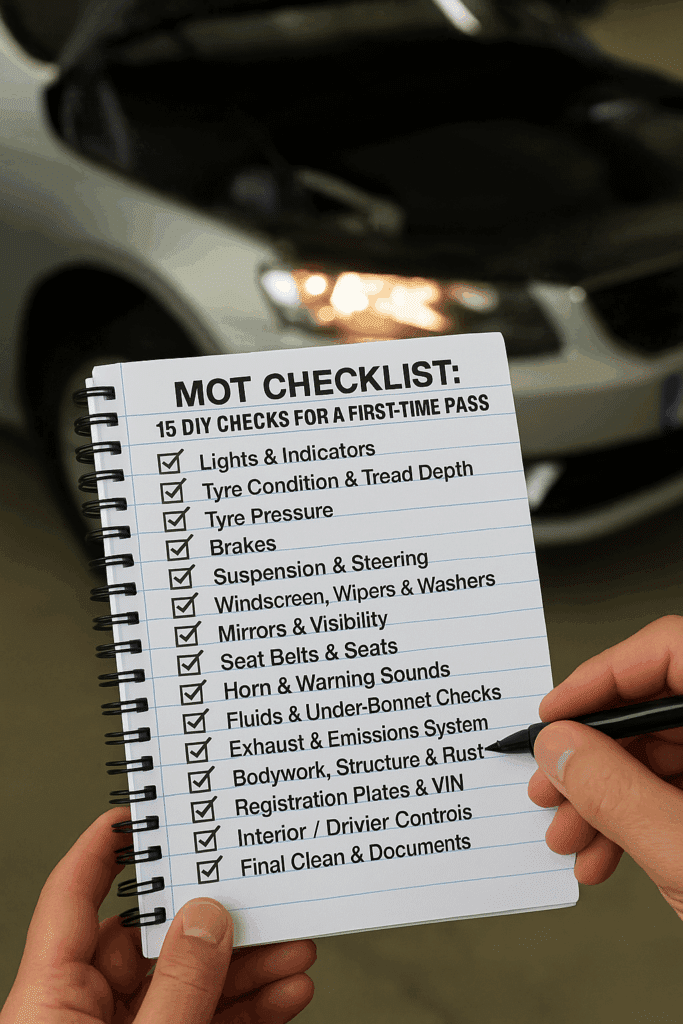
- Lights & Indicators: Walk around your car with the ignition on. Check headlights (dipped and main beam), indicators, brake lights, fog lights, hazard lights, and the number plate light. Replace any dead bulbs—they’re cheap and easy to swap.
- Horn, Wipers & Washers: Give the horn a blast to confirm it works. Top up screen wash and check that your wipers sweep cleanly without smearing. Split rubber blades are an instant MOT fail.
- Mirrors & Windscreen: Ensure mirrors are secure and your windscreen is free from major chips or cracks, especially in the driver’s line of sight.
- Seatbelts & Warning Lights: Buckle each belt to check that it latches and retracts properly. Turn on the ignition, and any airbag, ABS or engine warning lights that stay on will cause a fail.
- Tyres: Check tread depth (minimum 1.6mm across the central ¾ of the tyre). Use a 20p coin if you don’t have a gauge; if the rim is visible, your tyres are too worn. Look for bulges, cuts, or embedded objects, and inflate to the manufacturer’s specifications.
These DIY checks take less than 10 minutes and cover a significant portion of the most common MOT failures.
What Exactly Is Checked in an MOT? (Full MOT Checklist)
During an MOT, trained testers inspect over 25 different points on your car to make sure it’s roadworthy. Here’s a breakdown:
1) Brakes
- Pedal feel and responsiveness
- Handbrake/parking brake holding strength
- Condition of discs, pads and brake lines
- Brake balance across wheels
2) Steering & Suspension
- Excessive play in the steering wheel
- Power steering leaks
- Wear on springs, shocks and mountings
- Security of the steering rack and joints
3) Tyres & Wheels
- Correct size and fitment
- Matching pairs (no mixing radials and cross-ply)
- Tread depth and sidewall condition
- Wheel security (no loose bolts)
4) Lights & Electrical Systems
- Headlights, fog lights, indicators, hazards
- Beam aim accuracy
- Daytime running lights (on newer cars)
- Battery security and visible condition
5) Visibility
- Windscreen free from significant cracks/chips
- Wipers and washers are working effectively
- Demisting functions
6) Body & Structure
- No dangerous corrosion around seatbelt, suspension or brake mounts
- Doors, bonnet and boot open/close securely
- Chassis integrity
7) Exhaust & Emissions
- Exhaust is secure with no leaks or excessive noise
- Emissions tested to legal standards (including OBD check for modern cars)
- No excessive smoke
8) Seats, Seatbelts & Airbags
- Seat security and adjustability
- Belts latch, retract and aren’t frayed
- Airbag systems show no faults
9) Fuel System
- No leaks from tank, lines or injectors
- Fuel cap seals correctly
10) Underbody & Drivetrain
- Leaks from gearbox, differential or engine
- CV boots, gaiters and joints intact
- Secure engine and gearbox mounts
11) Dashboard & OBD Warnings
- ABS, EPS, airbag and engine lights must not be illuminated
- Fault code scan on newer cars
The Most Common MOT Failures (and Easy Fixes)
More than half of MOT failures are caused by issues that are inexpensive and easy to rectify. Here are the top culprits, and how to prevent them:
- Bulbs: One in five cars fails for a faulty bulb. Keep spares in the glovebox and learn how to swap them.
- Wipers & Washers: Torn blades or empty washer fluid tanks. Replace blades annually and top up screenwash regularly.
- Tyres: Worn tread, incorrect pressures or sidewall damage. Check pressures monthly and inspect for cuts/bulges.
- Brakes: Uneven wear or imbalance. If you notice pulling under braking or vibrations, have them checked early.
- Headlamp Aim: Misaligned beams can dazzle other drivers and cause a fail. If you’ve replaced bulbs recently, check the aim.
A quick pre-MOT check at a trusted garage can spot these simple issues before test day and save you the hassle of a retest.
When is my MOT due?
You can check online using your registration number. Many garages send free reminders so you don’t miss the renewal date.
MOT “Grace Period” Myth
There is no grace period. The moment your MOT expires, your car is illegal to drive (except to a pre-booked test). Driving without an MOT can lead to fines and may invalidate your insurance.
What to Bring
- Your vehicle (in a roadworthy condition)
- Current MOT certificate (if available)
- V5C logbook if your details have changed
MOT vs Full Service: Do You Need Both?
This is a common question at Autoveto Garage.
- MOT = Safety & Legality: Ensures your car meets minimum road standards on the day of the test.
- Service = Preventative Maintenance: Keeps your car reliable, efficient and warranty-compliant by replacing fluids and filters and inspecting wear items.
Skipping services may not cause an MOT fail, but it will shorten your car’s lifespan and increase running costs over time. Many drivers book their MOT and service together to minimise downtime and catch emerging issues early.
FAQ
How long does an MOT take?
Around 45–60 minutes, depending on your vehicle and how busy the test lane is.
Can I drive without an MOT?
No. Unless you’re driving directly to a pre-booked MOT test, it’s illegal and may invalidate your insurance.
What’s the difference between an MOT and a service?
The MOT checks road safety and emissions to legal standards. A service replaces fluids/filters and assesses wear to prevent breakdowns and maintain performance.
Do EVs and hybrids have different MOT checks?
Yes, though most items are similar. EVs skip tailpipe emissions but still undergo checks for brakes, steering, suspension, tyres, lighting, structural integrity and safety systems.
What happens if my car fails?
You’ll receive a failure certificate listing defects as dangerous, major or minor. Dangerous defects mean the vehicle must not be driven. Once repaired, you can return for a retest, often free or discounted if done promptly at the same garage.
Conclusion
Passing your MOT isn’t about luck; it’s about preparation. A few minutes spent on simple checks (lights, wipers, tyres, fluid levels and dashboard warnings) can eliminate the majority of common failures. Understanding what inspectors look for helps you plan maintenance, avoid last-minute stress and keep your car safe and compliant year-round. Whether you drive a petrol, diesel, hybrid or EV, using a structured MOT test checklist and staying on top of regular servicing will make the difference between an easy pass and an unexpected fail. With the right prep, your next MOT should be fast, straightforward and uneventful. MOT date approaching? Book your MOT test with Autoveto for DVSA-approved testing in Norbury.